
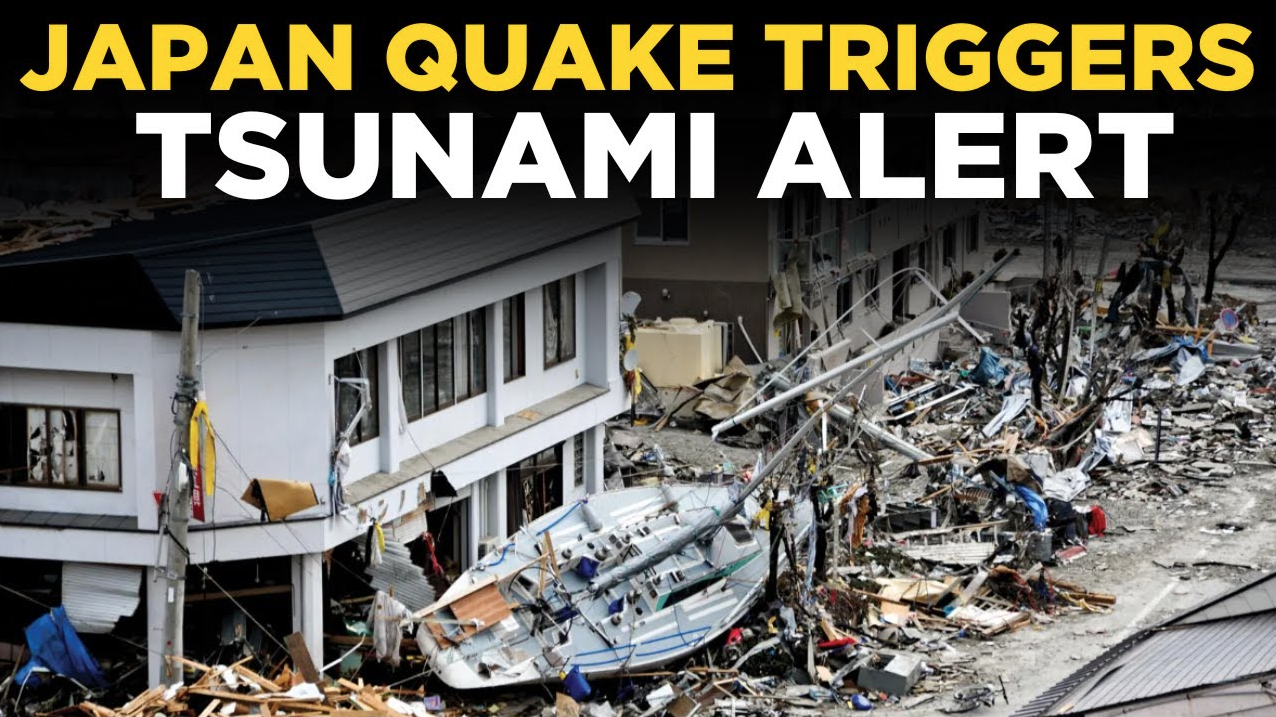
A powerful earthquake once again struck the northern coast of Japan on Sunday (November 9), prompting authorities to issue a tsunami warning. According to the Japan Meteorological Agency (JMA), the magnitude of the earthquake was measured at 6.8. The epicenter was located off the coast of Iwate Prefecture, at a depth of about 30 kilometers below the sea surface. The agency warned that tsunami waves of up to one meter (about three feet) could hit the northern coastal regions.
Quake Strikes Near Iwate at 5:03 p.m. Local Time
News agency AFP, citing the Japan Meteorological Agency, reported that the earthquake occurred at around 5:03 p.m. local time in the offshore waters near Iwate. Following the quake, a tsunami warning was issued for waves up to one meter high. Japan’s National Seismological Center stated that the earthquake’s epicenter was located in the northern Pacific Ocean at a depth of 30 kilometers.
Tsunami Waves Observed, Authorities Urge Caution
According to an AFP bulletin quoting the Japan Meteorological Agency, a tsunami warning was issued for the Iwate coast, cautioning that the waves could strike at any moment. Meanwhile, Japanese media reports mentioned that tsunami waves have already been observed in some areas. Authorities have urged residents to stay away from coastal regions for their safety.
Remembering the 2011 Japan Earthquake and Tsunami
This area is still affected by the devastating 2011 undersea earthquake, which had a magnitude of 9.0 and triggered a massive tsunami that killed or left missing about 18,500 people. That disaster also caused three reactors at the Fukushima nuclear power plant to melt down, marking Japan’s worst post-war catastrophe and one of the world’s most severe nuclear accidents since Chernobyl.
Japan: The World’s Most Seismically Active Region
Japan lies on the western edge of the Pacific “Ring of Fire,” where four major tectonic plates meet, making it one of the most seismically active countries in the world. The island nation experiences around 1,500 earthquakes every year, most of them minor. Today’s earthquake briefly reminded people of the 2011 catastrophe, when thousands lost their lives as a result of the quake and tsunami.
No Major Damage Reported So Far
However, no major casualties or damage have been reported from today’s quake so far. Earthquakes are common in Japan, often followed by tsunami threats. The most devastating earthquake in Japan’s history occurred on March 11, 2011, when a 9.0–9.1 magnitude quake struck the Tohoku (eastern Japan) region. Half an hour later, tsunami waves over 40 meters high struck the coast, causing widespread destruction.
The 2011 Disaster’s Lasting Impact
That natural disaster killed and displaced more than 18,000 people and caused extensive damage to infrastructure. It also led to radiation leaks at the Fukushima power plant, marking one of Japan’s most catastrophic natural disasters in history.